GLOBAL TRADER RANKINGS / RECORD COMPARISON
Trader Comparison Practice Packet
Four complete invented records and a five-event cohort register expose common ranking mistakes.
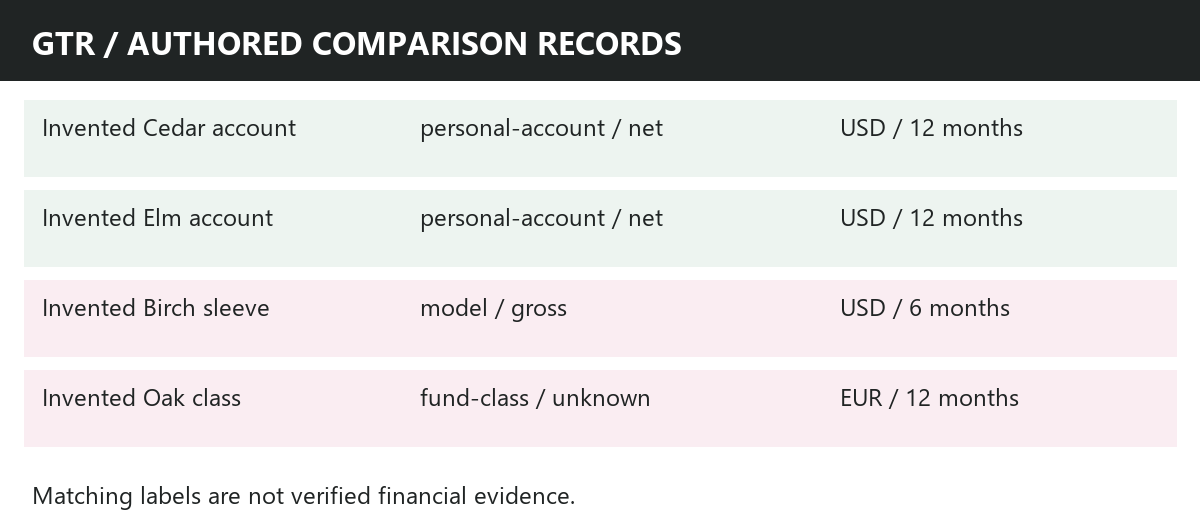
| Record | Object / cost | Interval | Currency | Source gap |
|---|---|---|---|---|
| Invented Cedar account | personal-account / net | 2025-01-01 to 2025-12-31 | USD | No real-account evidence; teaching case only |
| Invented Elm account | personal-account / net | 2025-01-01 to 2025-12-31 | USD | No real-account evidence; teaching case only |
| Invented Birch sleeve | model / gross | 2025-07-01 to 2025-12-31 | USD | No real-account evidence; teaching case only |
| Invented Oak class | fund-class / unknown | 2025-01-01 to 2025-12-31 | EUR | Drawdown and cost basis unresolved |
Read the comparison before the result
Cedar and Elm have matching supplied object, currency, date, cost and valuation labels. They pass only a metadata screen. Their invented returns do not become verified observations because the labels match. Birch has a shorter interval, simulated object and different cost and valuation definitions. Oak has a different currency and unresolved costs. The useful output is the list of incompatibilities rather than a manufactured global order.
Account for the original population
Five invented entries form this teaching population. The event register includes one withdrawal with an unknown outcome and one later backfill. The four visible calculation records are not the full historical denominator. No success-rate estimate is made from the two complete example records. Willow's absence remains an unknown outcome, not a zero return and not an allegation about any real person.
Inspect the complete public packet
The JSON includes all four authored records, the five-event membership register and explicit null fields for actual accounts and financial validation. The CSV contains the full record rows rather than an empty downloadable worksheet. The existing cohort worksheet remains available for your own record design. Educational downloads do not include private source snapshots or user input.
Reproduce one arithmetic case
For Birch's invented fifty percent gain over six months, the annualised equivalent is one hundred twenty-five percent. A supplied twenty percent drawdown has a twenty-five percent recovery equivalent. Neither calculation establishes the real equity path, a realised year or a future recovery time. Cedar's twelve-month pace remains twelve percent. The tool keeps arithmetic and metadata compatibility separate.
Cedar and Elm: matching labels do not prove a winner
Both invented personal accounts have a net label, marked-equity basis, USD currency and common calendar interval. The bridge therefore returns matching supplied metadata. It does not certify those labels, costs or the presence of complete source records. Elm's smaller supplied drawdown also does not establish a superior future risk process. A real comparison would require the underlying series and comparable observation frequency. The packet intentionally withholds real-world ranking and financial validation.
Birch and Oak: keep different gaps separate
Birch is a model sleeve, has a shorter period and reports before-cost closed-balance observations. These differences are not resolved by its attractive annualised equivalent. Oak has a EUR reporting label and an unknown cost definition and drawdown. Do not treat unknown drawdown as zero or translate the whole record with a current exchange rate. The practical task is to name the missing records that would permit a narrower comparison, not to make every cell look complete.
Complete packet (JSON) | All record rows (CSV) | Open the period bridge