When Two Trader Records Can Actually Be Compared
Build a comparison cohort before assigning ranks: account type, mandate, time period, capital, missing entrants and evidence quality.
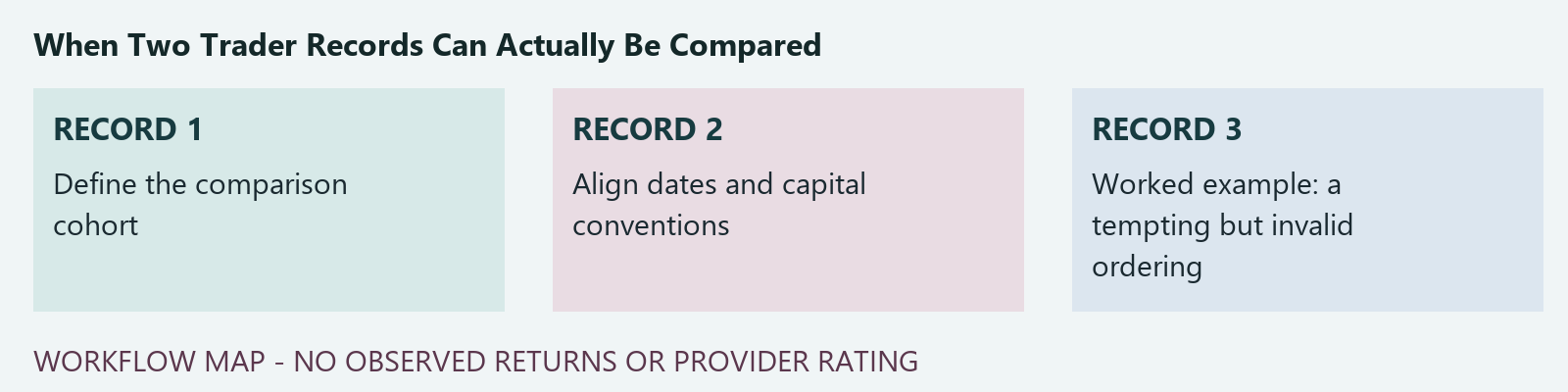
Define the comparison cohort
A list of famous names is not yet a measurable leaderboard. Begin with the object being compared: a personal account, a fund, a strategy sleeve or a competition account. Name the population and its admission date before looking at returns. A trader can operate several accounts with different risk limits, while a fund result may involve a team and a changing mandate. Combining those records into one person-level score hides decisions about ownership and attribution. Publish the cohort definition before any ordinal position.
Align dates and capital conventions
Compare the same observation interval where the sources permit it. A partial year cannot be converted into a full-year realised result merely by annualising it. Record starting capital, leverage, external flows, currency and gross-versus-net treatment. Identify whether returns describe marked equity, closed balance or an inferred series. The GIPS standards provide performance-reporting scope references; invoking them does not establish that a profile or this publication complies with the standards. A source link is a starting record, not an assurance badge.
Worked example: a tempting but invalid ordering
Consider three invented entries. Account A reports 12% over a full year after fees, account B reports 18% over one quarter before fees, and fund C reports 10% over the year with monthly liquidity and a different currency. Sorting 18, 12 and 10 would make B first, but it would not answer a common-period, common-cost question. B has nine months of missing information; C has a different reporting object. The useful output is a comparison table showing those gaps, not an adjusted score built from guessed missing returns.
Treat missing entrants as part of the design
Keep admission, removal, closure and backfill dates for the original population. A currently visible profile directory does not show accounts which disappeared after losses or stopped publishing. Do not infer a success rate from the surviving names. If historical membership cannot be recovered, narrow the question to the records currently documented and state that limitation. Deduplicate multiple accounts belonging to the same trader only under an explicit rule; otherwise either the trader or the strategy can be counted repeatedly.
Risk measures need the underlying series
Drawdown, volatility and Sharpe are not interchangeable descriptions of skill. Each requires a stated observation frequency, valuation method and return definition; some need assumptions about the sampling process. A single cumulative return cannot reconstruct the path of risk. Keep uncertainty and missingness visible rather than converting every field into a factor score. Changing weights after seeing who tops the table is another selection decision. Freeze the scoring design first if an actual, adequately sourced scoring exercise is eventually commissioned.
What this publication can honestly conclude
No primary per-trader source records were supplied for new return or factor-score calculations. Accordingly this chapter explains an evidence protocol, not a fresh global ranking, ELO calculation or empirical comparison. A qualitative profile can describe a documented mandate and point to primary records without assigning unsupported numerical superiority. The blank cohort worksheet distinguishes source status from score eligibility. Leave a rank empty when the comparative question cannot be answered; an honest missing value is more useful than a precise-looking number with no reconstructible basis.
Decision record
| Question | Record to retain | Decision boundary |
|---|---|---|
| Population | Admission list, removals, closures and backfill dates | A directory is not a historical denominator |
| Return object | Account, fund or sleeve and its mandate | Do not equate fund performance with a personal account |
| Comparable interval | Common dates, currency and fee convention | No ranking from mismatched headline percentages |
| Risk path | Dated equity or return observations | No reconstructed risk score from cumulative return alone |
Blank working record
The worksheet contains column headings only. Enter your own dated observations, keep absent evidence marked unknown, and do not treat the file as certification.
 Download worksheet (CSV)
Primary references
These documents support mechanisms and source definitions, not a tested trading result or a recommendation. Accessed 9 October 2026. The decision workflow and invented examples above are editorial exercises.
Keep reading
Publication methodology | Working glossary | Source and correction policy